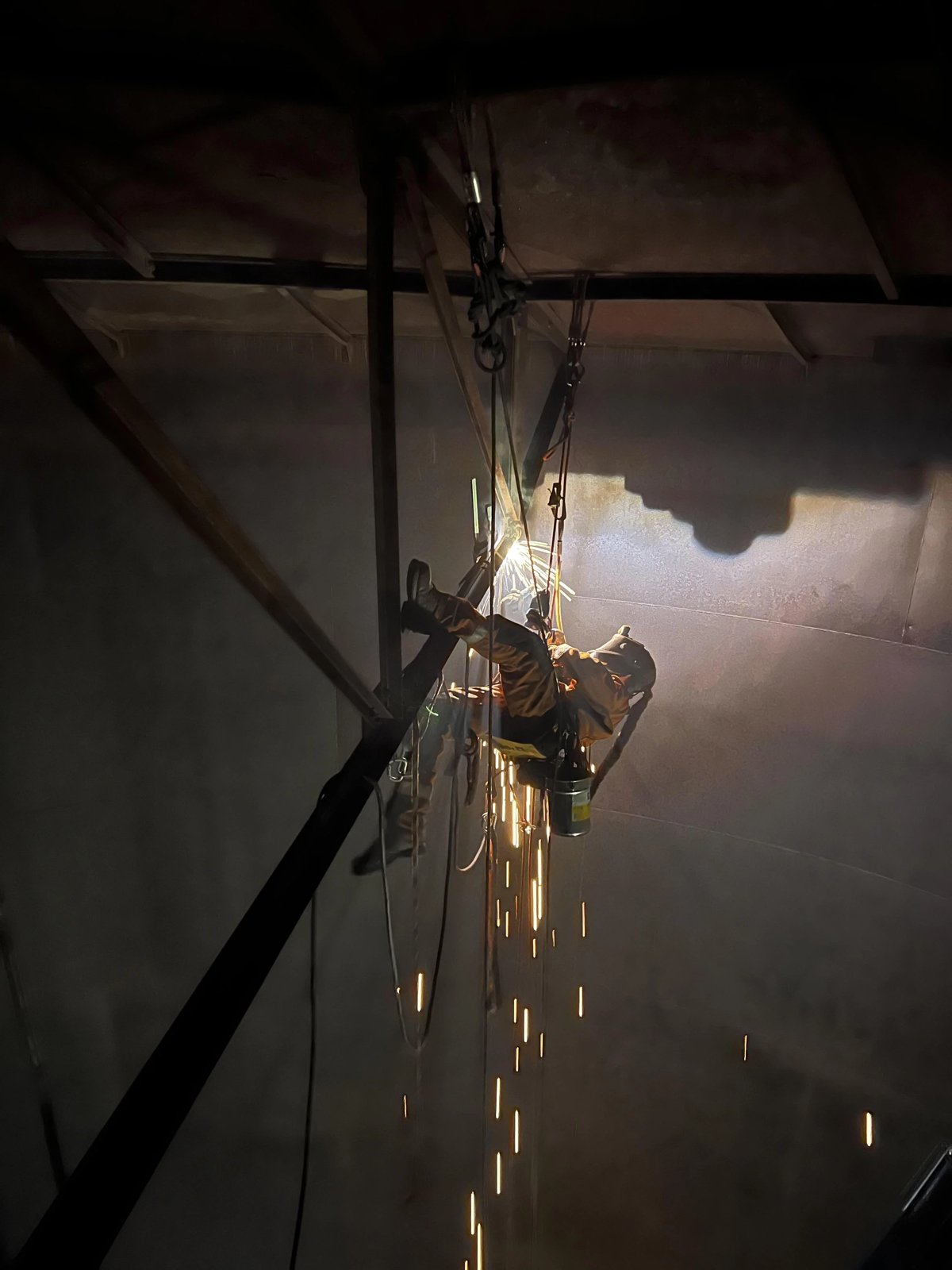
Coded welding on ropes by an IRATA-trained rope access welder. Michael abseils down the side of a vessel, into a tank or across a steel structure and welds to the same coded standard as on the ground, without the cost and lead time of scaffold or a powered platform.
Scope scales with the project, but these four are the spine of any rope access welding engagement with MMA Welding.
Over-side hull repairs with ropes rigged off the vessel itself. Weld repairs on ships, barges and workboats at the berth, without waiting on dock scaffold.
Internal rope drops into ballast tanks, silos and hoppers. Combined with confined-space tickets, hot-works permits and a proper rescue plan.
Gantries, masts, bridges and high steelwork. Rigged, dropped in, welded out and de-rigged in a fraction of the time scaffold takes.
The same BS EN ISO 9606-1 coded procedures apply on ropes as on the ground. Weld quality does not change with the altitude.
IRATA is the international industrial rope access trade association, the standard for working safely on ropes across marine, offshore and construction. Michael holds IRATA Level 1, working as part of a rope access team under a Level 3 safety supervisor, as the IRATA system requires.
Yes. The welding procedure, consumables and coded standard are exactly the same. Rope access only changes how the welder reaches the joint, not how the joint is welded.
Almost any job where the access is the expensive part: ship sides, tank internals, high steelwork. There is no scaffold hire, no erection time and no dismantle, so short-duration weld repairs at height are usually days faster and significantly cheaper.
MMA Welding covers the M25 and Medway area day-to-day, and travels across the whole of the South East: Kent, Sussex, Surrey, Hampshire, Berkshire, Buckinghamshire and Oxfordshire, plus London, Essex and the wider Home Counties, anywhere within around 100 miles of Gravesend.
Drop a quick message with what needs welding, where it is and a photo if you have one. Michael will come back the same day.